Insights
AI ambition is rising. How can growth businesses meet it?
Explore the first of our Growth Guides series, which benchmarks SME progress on AI adoption and provides practical guidance to help them move from experimentation to value generation.
24 September 2026
Click here to read the full report, for the complete research findings, portfolio examples and practical guidance for management teams.
Artificial intelligence (AI) has rapidly moved up the agenda for growth businesses. Across sectors and stages, ambition around adoption is increasing as leaders recognise its strategic importance. Despite this, relatively few SMEs have succeeded in integrating it at scale.
In the first of our Growth Guides series, our Value Creation team spoke to more than 250 entrepreneurs and management teams throughout the UK & Ireland to understand the gaps between aspiration, implementation and value generation. Read on to discover the findings, alongside guidance from BGF’s Data & AI experts, views from our specialist network and first-hand experiences from our portfolio.
Confidence is high, but scaled adoption remains limited
Most SME leaders acknowledge the fundamental role of AI. More than seven in ten say it is important to their business today, rising to 75% in relation to their long-term growth ambitions. Sentiment is also improving: 84% are more optimistic about, or trusting of, AI than they were 12 months ago.
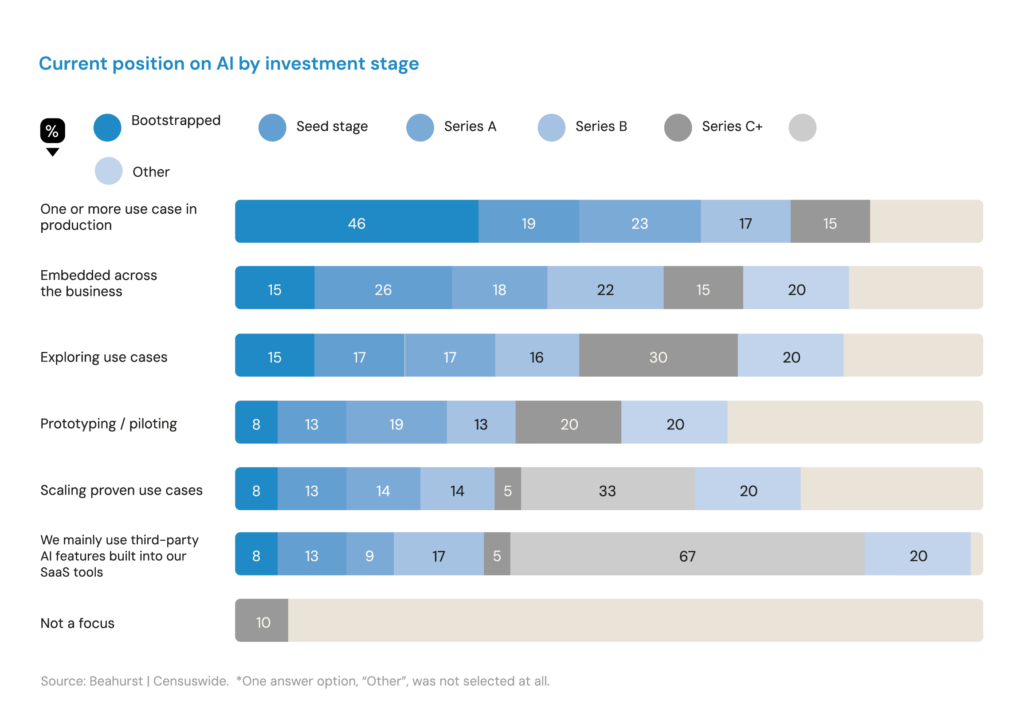
Despite this, implementation has not matched perceived value. Only 10% of respondents describe AI as fully integrated across their organisation, while many remain at the exploration, prototyping or pilot stage. Pilots may have been sufficient to give early adopters a head start, but as AI becomes more accessible, embedding it effectively and building on the resulting knowledge will become more important than piecemeal use cases.
For many businesses, the most effective starting point is a focused use case with a clear commercial outcome, accessible data and a fast feedback loop, which builds confidence and evidence before expanding further.
The biggest barriers are not purely technical
AI implementation is often discussed as a technology challenge. Our findings suggest that the reality is more nuanced. Although security constraints (38%) and data quality issues (37%) were among the top barriers, the most frequent response was AI skills (40%). Employee adoption (37%), change management (37%) and concerns over ROI (34%) also ranked highly – demonstrating the combination of human and technical factors at play.
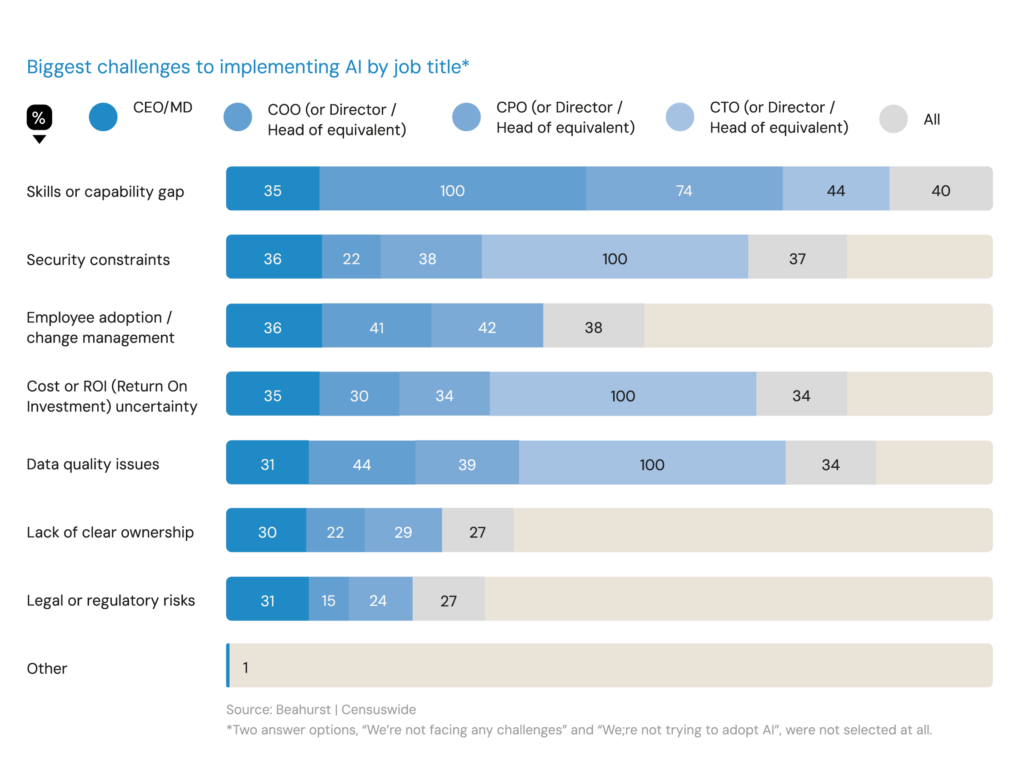
The clustering of these challenges indicates businesses are rarely held back by one isolated issue. Instead, progress depends on a combination of a capable workforce, reliable data, internal coordination and organisational governance. Even so, the human element is clearly fundamental. Even if an AI tool works perfectly, encouraging people to use and trust it represents a critical obstacle.
That puts a premium on visible leadership, giving teams protected time to experiment, creating clear ownership and encouraging senior leaders to model new ways of working.
“Founders must recognise two common barriers to learning: people may associate learning with past failure, or fear looking incompetent after years of success. Organisations therefore need psychological safety, visible experimentation and leaders who actively role-model learning.”
Claudia Harris
Chief Executive Officer, Makers
Governance can enable businesses to move faster
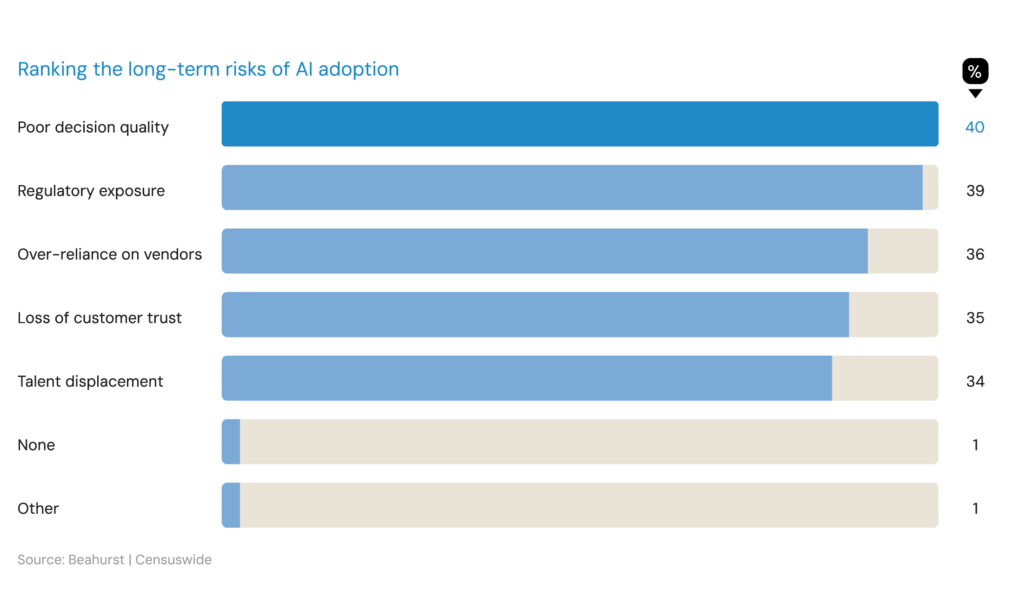
Awareness of AI risk is already high. In contrast to the clear ambition to harness the technology, more than half (56%) perceive it as a threat. Leaders’ concerns were evenly spread across poor decision-making by AI (40%), regulatory exposure (39%), vendor over-reliance (36%), loss of customer trust (35%) and talent displacement (34%).
But SMEs are acting on these fears; almost two thirds (64%) already have a responsible AI policy in place and a senior leader responsible for AI strategy. The next challenge is translating those structures into everyday practice and ensuring AI policy evolves and is proportionate to every organisation’s use of the technology.
In practice, governance should scale with the use case – from guidance on acceptable use for off-the-shelf tools to stronger data controls and human oversight where AI informs customer-facing or material decisions.
“Effective AI governance is what gives organisations the confidence to scale adoption. Trust is built when AI is designed to support professional judgement rather than replace it, with clear accountability, appropriate oversight and robust data governance embedded from the outset. Alongside that, the quality of the technology and support also earns trust, which in turn drives adoption. Getting both right is the key to extracting maximum value from AI.”
Dr. William Cook
Commercial Partnerships (UK&I), Tandem Health
Growth businesses want practical support
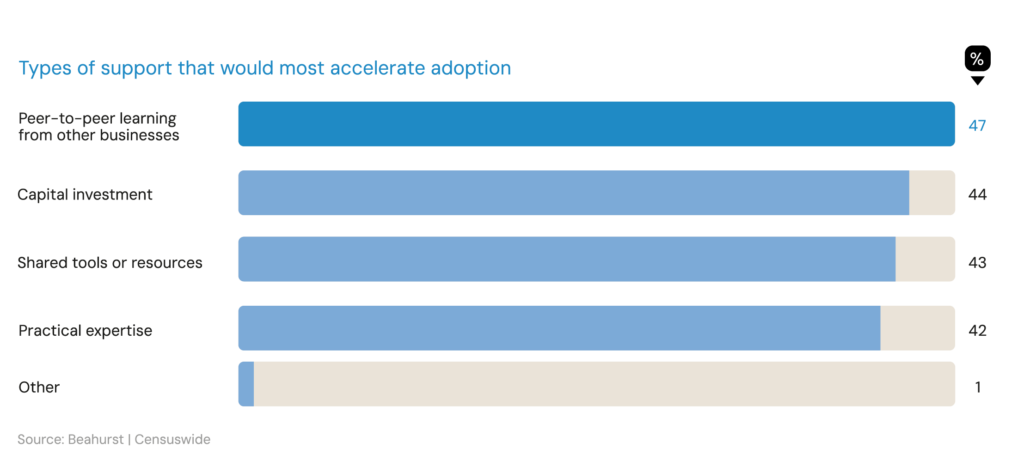
Few leaders expect to navigate a transition as significant as AI alone. More than four in five respondents (83%) said that access to an external AI adviser would be beneficial, although peer-to-peer learning was the most selected form of support that could tangibly accelerate adoption.
Almost all respondents also believe investors should play a role. The strongest demand is for practical operating support, active strategic partnership and input on governance, rather than capital alone.
This reflects BGF’s experience across its portfolio. The businesses making the fastest progress are not necessarily those pursuing the largest or most complex AI programmes. They have often identified a focused opportunity, accessed relevant expertise and built internal confidence through delivery.
“Businesses need to get comfortable with shorter cycles and accepting that some of what they build today will be superseded quickly. That is not a reason to slow down – it is a reason to capitalise quickly on today’s technology and be ready to pivot when the next AI capability appears. Perhaps counterintuitively for some organisations, this means identifying smaller, impactful and higher-learning bets rather than multi-year transformation programmes.”
Tom Pearson
Head of Data, BGF
Moving from intent to value
AI adoption will not follow the same path in every organisation. Sector, size, business model, data maturity and internal resource will all shape the right approach. However, the research shows that intent and confidence will only take you so far. Progressing from experimentation to meaningful adoption requires businesses to combine the right use cases with strong data foundations, clear leadership and effective governance.
The data and AI experts in our Value Creation team partner closely with portfolio companies to convert ambition into practical implementation and unlock long-term growth. Whether funding for projects around data infrastructure and advanced analytics, or tailored strategic guidance and hands-on community workshops, find out more about the support available here.
Download the full report, BGF Growth Guide: Unlocking Value from AI, for the complete research findings, portfolio examples and practical guidance for management teams.