



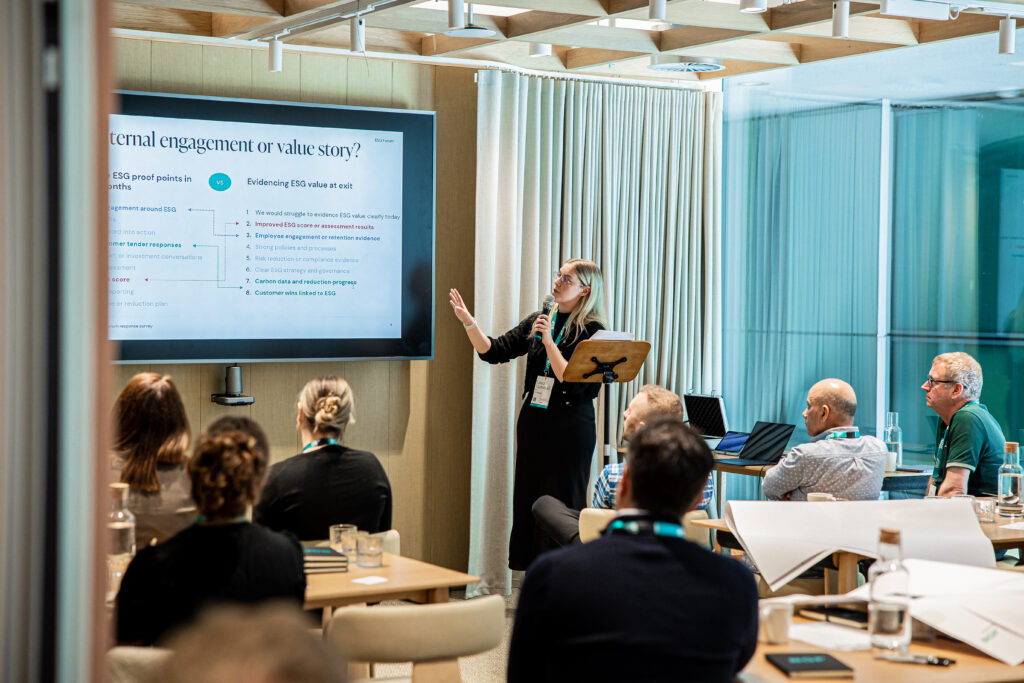
Every year, we bring together ESG and sustainability leaders from across the BGF portfolio to step away from their day-to-day and have honest conversations about what’s helping (or hindering) ESG progress in their businesses.
When we met in London for our fourth annual ESG Forum in June, I was reminded that the real challenge is not ambition, but prioritisation. Businesses do not need a perfect strategy; they need clarity on what matters most and the confidence to act on it.
Working with growth businesses, I rarely meet leadership teams that don’t care about ESG. Most genuinely want to do the right thing. They understand that expectations are changing (from customers, employees, investors and regulators) but they’re also trying to grow businesses at pace, often with lean teams and competing priorities.
AI is a good example of that.
Sarah Gillard, CEO of A Blueprint for Better Business, delivered a keynote at the Forum that challenged us to think beyond productivity gains and ask a more fundamental question: what kind of organisation do we want to be, and what role do we want AI to play in helping us get there?
Unsurprisingly, it was a conversation that kept resurfacing throughout the day. AI is no longer something businesses are planning for in the future; it’s already changing how decisions are made, how teams work and how organisations interact with their customers. As adoption accelerates, the conversation is shifting from whether to use AI to how to use it responsibly. That’s where I think ESG has an important role to play.
The challenge isn’t just about adopting AI. It’s making sure it’s deployed in a way that builds trust, strengthens governance and delivers positive outcomes for employees, customers and society. That means thinking carefully about where human judgement should remain, how boards oversee AI adoption and how organisations ensure new technologies stay aligned with their purpose and values.
But AI is only one of the many decisions leadership teams are trying to prioritise right now. Alongside climate, regulation, talent, supply chains and customer expectations, it reinforces something I see time and again: growing businesses can’t do everything at once, and they shouldn’t try to.
The organisations making the greatest progress aren’t necessarily doing more than everyone else. They’re making deliberate choices about where to focus first. They understand what matters most to their business and they build from there.
Part of my role at BGF is to help management teams prioritise which ESG issues are most closely connected to the business’s strategy, operations and long-term success. Sometimes that’s helping define meaningful KPIs. Sometimes it’s introducing specialist expertise or connecting businesses with others in the portfolio who have tackled similar challenges.
The experience of BB7 highlights this practice. The UK’s leading specialist consultancy in fire and façade engineering had initiated a range of ESG activities, but these were disconnected from its strategic growth plan.
We worked with the leadership team to prioritise initiatives and establish a practical ESG framework with clear Board oversight and three-to-five-year targets. This included carbon emissions measurement, assessing B Corp against ISO 14001 and developing a tailored ESG strategy and governance approach.
This approach has enhanced BB7’s market positioning and investor confidence, while tighter governance and improved transparency have helped position its B Corp certification as a compelling differentiator within supply chains.
Of course, the priorities will look different for every organisation. A manufacturer may need to focus first on energy, materials and supply-chain resilience, while a technology business may place greater emphasis on data, AI governance and workforce skills.
The important thing is to make those choices deliberately. Leadership teams should consider where the business has the greatest impact, where the most significant risks and opportunities lie, and where action can support wider commercial priorities.
Prioritisation turns ESG from a broad agenda into a manageable one. It gives businesses a clearer basis for setting goals, allocating resources and measuring meaningful progress. The businesses that get this right will not only be better placed to respond to changing expectations. They will be more resilient, more trusted and better equipped for long-term growth.